Top Signs You Need Garage Door Service – Don’t Ignore These
A garage door that hesitates for half a second before it moves is trying to tell you something. Ignore it long enough and that half-second pause becomes a door that won’t open on the morning you’re already late for work. The signs of a failing garage door rarely announce themselves with drama. They show up as small, easy-to-dismiss behaviors that get worse on a predictable schedule. Catching them early is the difference between a quick tune-up and an emergency call. And if you’d rather not climb a ladder to investigate, call (866) 521-4006 and we’ll take a look.
What are the warning signs you need garage door service?
The warning signs of a garage door problem fall into three tiers of urgency. Knowing which tier you’re in tells you whether to schedule a visit or stop using the door. Most homeowners wait until a door stops working entirely, which turns a manageable fix into an emergency. Here’s how we rank them.
Low urgency: watch and schedule
- Hesitation or stuttering. The door pauses briefly before it starts moving. That’s usually an opener under strain or a roller binding in its track, not a motor losing power.
- A single squeal or grind that comes and goes. An occasional noise points to dry rollers or worn hinges. It’s worth a look before it turns into constant grinding.
- Slow, uneven travel. The door moves but feels sluggish on one side.
Medium urgency: call this week
- Visible cable slack. A cable that hangs loose instead of staying under tension is a real safety concern. Stop using the door and call today.
- Door sagging on one side. This usually means one of the lift cables or springs has lost tension. Running the opener on a sagging door puts stress on both sides.
- The opener strains or the door reverses before closing. Could be a sensor issue or a failing spring doing double duty.
High urgency: stop using the door immediately
- A loud bang from the garage. That sound is often a torsion spring snapping. The door may still close once because the opener carries it, but it’s dangerous. Don’t run it again.
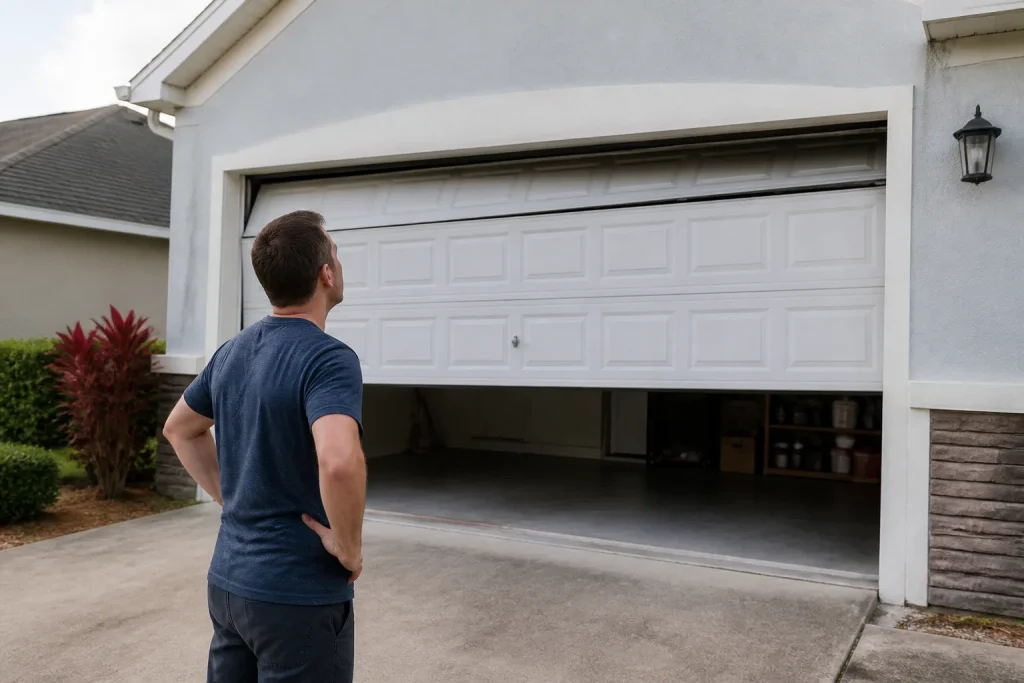
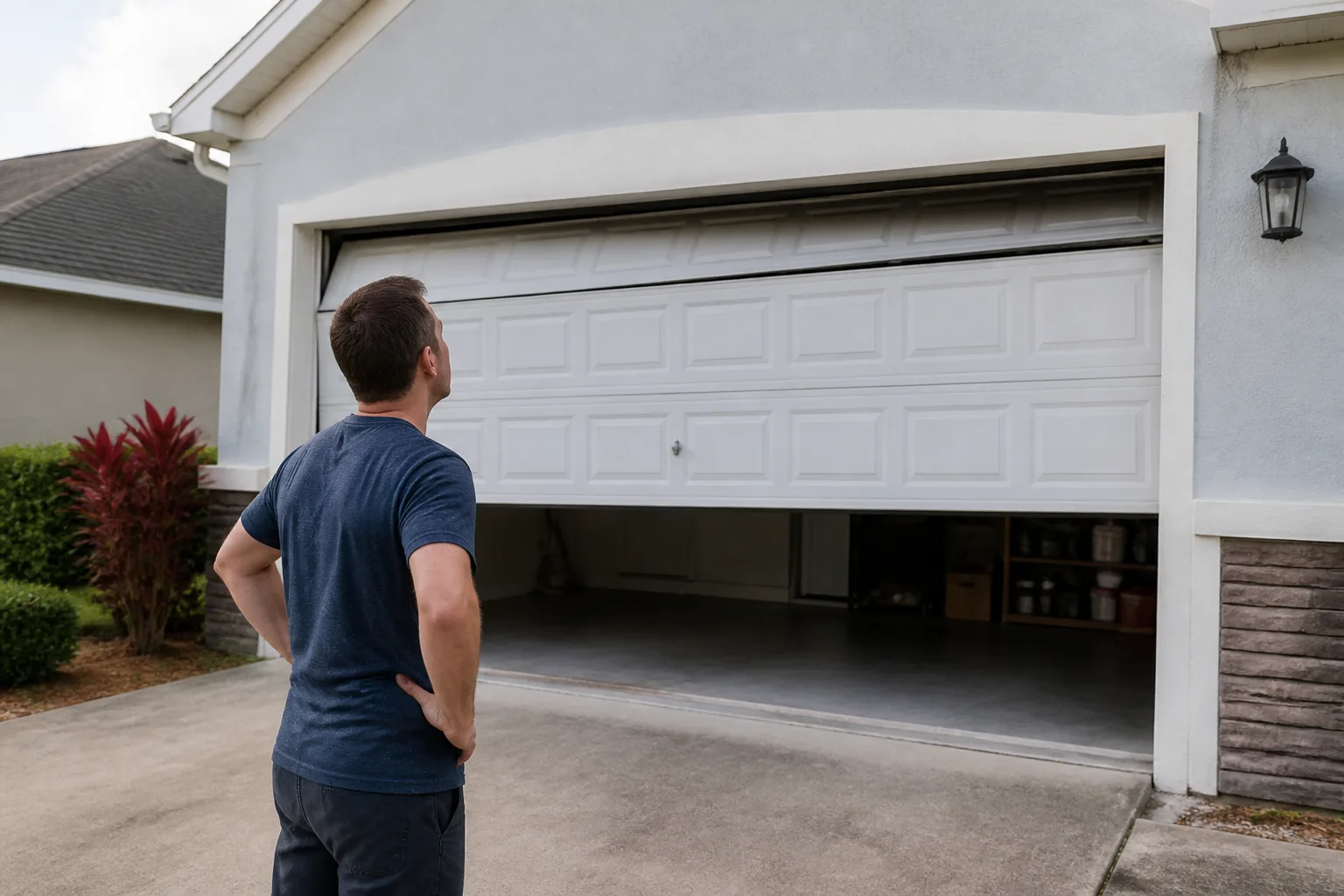
- The door hanging crooked or off the track. A door that’s come out of its tracks can fall. Keep clear and call.
- A door that won’t stay closed. This one needs attention fast because it leaves your home open.
We’ve walked into plenty of Riverview garages where a small hesitation was ignored for a season and turned into a snapped spring. The pattern is consistent enough to predict.
The noise diagnostic: what each sound is telling you
Homeowners often assume a noisy door just needs lubrication. Sometimes that’s true, but the type of noise is a clue about which component is failing. Listen carefully before you reach for the grease gun.
- Grinding. Usually metal on metal, often worn rollers or a dry torsion tube. Grinding that gets louder over time points to bearing wear, not just a lube issue.
- Squealing. High-pitched squeals typically come from dry hinges, rollers, or a worn opener gear. Grease helps briefly, but if it comes back within a week, a component is wearing out.
- Popping. A sharp pop or snap when the door moves often points to a torsion spring under stress or a section cracking. Get this checked before the pop becomes a bang.
- Rattling. Loose bolts, worn hinges, or a track that’s come loose from its bracket. Rattling is rarely urgent on its own, but it’s an easy early fix.
- Buzzing from the opener unit itself. Usually an opener issue, not the door. Worth a diagnostic on the opener before it dies mid-use.
These sounds don’t map perfectly to one brand or model, but knowing whether you’re running a LiftMaster, a Chamberlain, or a Genie unit helps us narrow it down before we arrive. We’re certified to service Raynor, LiftMaster, Chamberlain, and Genie systems, along with the other major brands, so the diagnostic is faster when we already know the hardware.
Why intermittent problems are more urgent than consistent ones
This one surprises people. A door that fails every single time is annoying, but it’s predictable. A door that fails once a week and works fine otherwise is under stress that’s about to become permanent failure. Intermittent behavior means a component is on the edge of its tolerance, and the next failure could be the one that leaves the door stuck down.
A few intermittent patterns we see a lot:
- The door works all week, then stalls once on a humid morning.
- The opener reverses before closing only on hot afternoons.
- The door closes fine, then fails to open the next morning.
Each of these points to a different underlying cause, from a sensor misalignment to a spring losing tension in temperature swings. But the pattern is the same: an intermittent problem is a warning, not a quirk to live with. If your door is misbehaving once a week, it’s already asking for garage door repair before it fails completely.
Seasonal signals in Riverview: late spring and after storm season
Riverview homeowners should pay extra attention to their garage door at two points in the year. The first is late spring, when day-to-night temperature swings stress the metal in springs, tracks, and hinges. Metal expands and contracts with every swing, and over time that fatigue shows up as a spring that’s lost some of its lift. If you notice your door feeling heavier by the end of spring, the springs are the first place to look.
The second is after summer storm season. Florida’s summer storms are hard on the electrical side of a garage door: opener boards, safety sensor alignment, and wall-mounted control wiring all take a beating. After a storm, check the safety sensors at the base of the track. If the indicator light is blinking rather than steady, the sensors need alignment or the wiring needs a look. Electrical and opener issues are a job for a trained technician, not a Sunday afternoon project.
Seasonal checks catch these problems before they become emergency calls. If you’re noticing either of these patterns, a garage door opener repair diagnostic covers the electrical side, and spring service covers the mechanical side.
The balance test every Riverview homeowner should do twice a year
A balance test tells you whether your springs are still doing their share of the work. It’s a simple check and it’s worth doing twice a year, once in late spring and once after summer. Here’s how:
- Close the door and disconnect the opener using the manual release pull.
- Lift the door about halfway by hand and let go.
- A balanced door holds roughly in place or drifts slowly. A door that slams down or rises on its own is out of balance.
Stop if it doesn’t feel right. If the door feels unusually heavy, won’t stay put, or slams down fast, don’t force it. A door that’s out of balance is under spring tension that can release suddenly. Springs and cables are the most hazardous part of a garage door to work on, and this is a service for a trained technician. Our team offers a dedicated garage door spring repair service precisely because it’s a job that deserves its own attention.
Why we treat spring issues as a safety decision, not a convenience
Spring replacement is not a DIY repair. Torsion springs store enormous energy, and a cable under tension can do real damage if it releases wrong. When we hear “the spring snapped, I’ll just order one online,” we always gently steer the homeowner toward a pro. It’s not about the parts cost, it’s about the danger.
The other reason to have springs looked at by a pro is that the cause matters. A spring can snap from age, from a bad balance, from a worn cable, or from a roller that bound up and stressed everything else. Replacing the spring without fixing the underlying cause just kicks the problem down the road. When we diagnose a spring issue, we look at the whole door: rollers, cables, hinges, and the opener’s strain. That’s why one call covers the whole job instead of one piece at a time.
When to call a pro
If you’re seeing any of the medium- or high-urgency signs above, call now. Cable slack, a sagging door, a loud bang, or a door hanging off its tracks should not wait. If you’re seeing only low-urgency signs, you have time to schedule, but don’t let a squeal or a hesitation ride until it becomes an emergency. Small issues get cheaper and faster to fix, and a door that’s caught early is a door that keeps working. If you’d rather have us check it than guess, that’s what we’re here for.
For emergencies, garage door service is one of our core offerings. We’re set up for calls when a door won’t close at night or won’t open in the morning, not just weekday repairs. Our technicians have up to 8 years of experience, and we service the major brands, including LiftMaster, Chamberlain, Genie, and Clopay, so we arrive already familiar with your hardware.
The Bottom Line
The early signs of a failing garage door are quiet: a half-second hesitation, a single squeal, a door that works all week and then doesn’t. Catch them and you’re looking at a tune-up. Ignore them and you’re looking at an emergency. The three-tier urgency list, the noise diagnostic, and the twice-yearly balance test above are the tools to tell the difference. And if you’d rather have a trained eye on it, we’re happy to take a look. For more on who we are and what we handle, see Riverview Garage Door Repair Co.
If you’re in Riverview and need help, Riverview Garage Door Repair Co offers free estimates – call (866) 521-4006.
Frequently Asked Questions
Look for hesitation before the door moves, unusual noises like grinding or squealing, a door that sags on one side, or a door that fails intermittently. Any of these is a sign to have the door checked before the problem turns into a complete failure. Call (866) 521-4006 for a free estimate.
A loud bang from the garage usually means a torsion spring has snapped. Stop using the door immediately and call a pro. The door may still move once, but it’s dangerous to operate with a broken spring, and springs are a job for a trained technician, not a DIY fix. Call (866) 521-4006 to get it looked at.
Yes. A door that fails occasionally is under stress that is about to become permanent failure. Intermittent problems are often more urgent than consistent ones because the next failure could leave the door stuck. Call (866) 521-4006 for a diagnostic before it becomes an emergency.
We strongly advise against it. Garage door springs store enormous energy, and a spring or cable that releases wrong can cause serious injury. Spring replacement is a safety decision, which is why we offer it as a dedicated service handled by technicians with up to 8 years of experience. Call (866) 521-4006 for a free estimate.
Written by the team at Riverview Garage Door Repair Co.
Need Garage Door Help?
Call Riverview Garage Door Repair Co - the local pro we connect you with is licensed and insured, here with fast after-hours help in Riverview.
(866) 521-4006